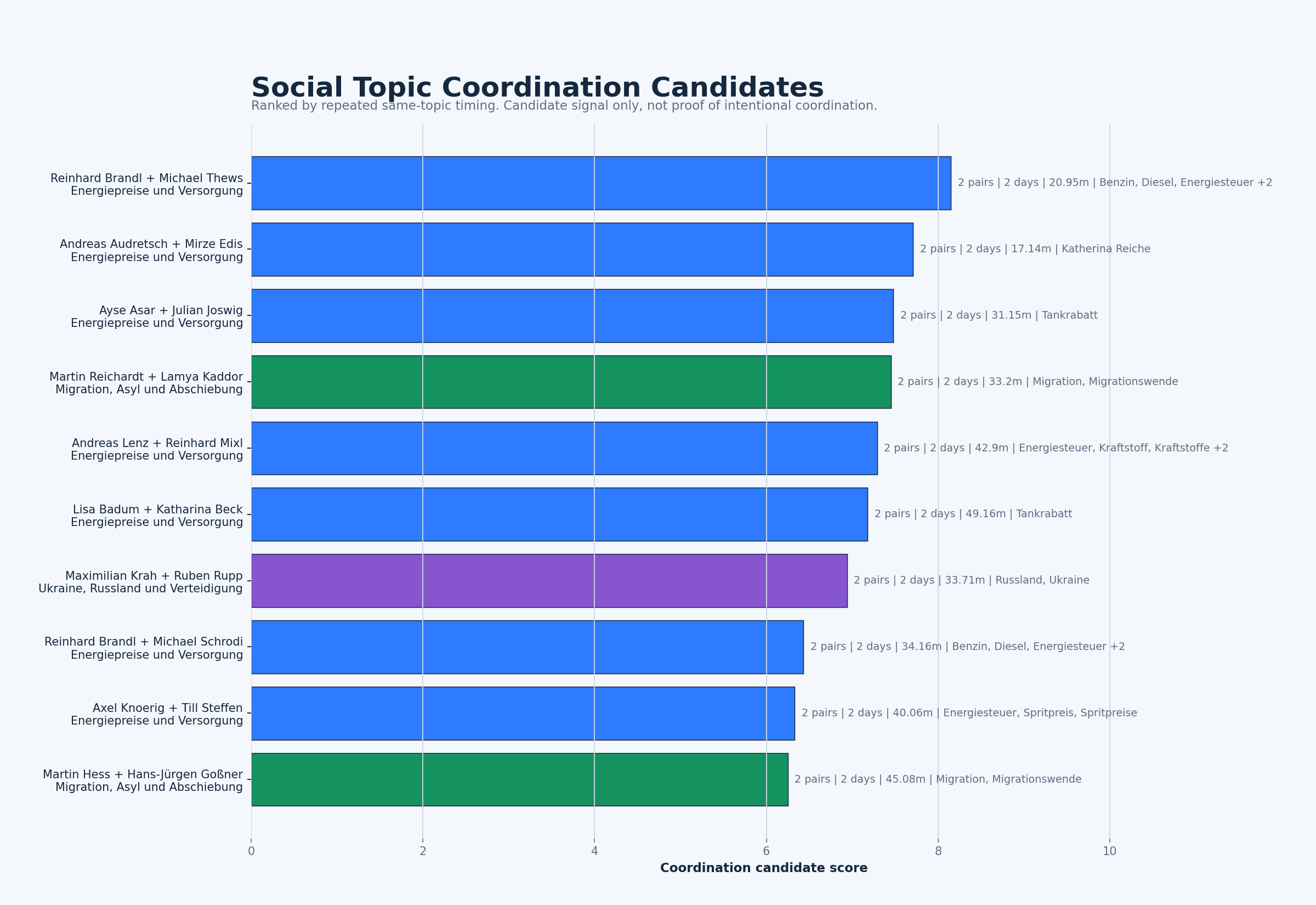
What Stands Out
- The 90-minute window finds many more raw signals, but many are weaker: single news events, government communication, or broad energy vocabulary.
- The final public selection therefore does not simply follow the raw ranking. It uses a conservative reclassification based on readability, specificity, and recurrence across days.
- Energy prices, fuel discounts, and Katherina Reiche shape the clearest cases; migration appears more as an agenda collision with opposing messages.
- The findings remain research leads: shared news context, party communication, official government messaging, and direct interactions can produce similar traces.
The Short Reading
This analysis does not ask who coordinated behind the scenes. It asks where social media data looks like several MPs posted very close together about the same topic. To do that, posts from X, Instagram, and TikTok were normalized into a shared schema, matched against deterministic topic terms, and compared pair by pair.
In the final check, the timing window was widened from 60 to 90 minutes. That expands the raw pool from 981 to 1,467 near post pairs and from 10 to 25 candidates. That is exactly why the selection then had to become stricter: not every additional signal is useful as a public story.
What the 90-Minute Check Changes
The wider window makes the analysis more sensitive. It catches more political reaction waves, but also more cases that occur on only one day, reflect official coalition communication, or are connected through broad terms such as energy, petrol, or diesel.
That is why the deterministic search is followed by two review layers: Gemini 3.1 Flash Lite as a second look at the evidence, and then a stricter Codex reclassification. The public selection is based not just on score and timing, but on readability, specificity, recurrence across days, and the risk of misleading interpretation.
What the Pattern Shows
The strongest cluster is about energy prices and fuel costs. Several pairs share terms such as petrol, diesel, fuel tax, fuel prices, or fuel discount. That fits the political news cycle in the period: coalition decisions, relief debates, and reactions to energy prices created short, dense communication waves.
The crucial distinction is between a coordination signal and proof of coordination. If two MPs post within minutes about the same decision, it may reflect an aligned communication line. It may also be a quick reaction to a press conference, news alert, or parliamentary debate. The method therefore marks candidates, not culpability.
Why These Cases Matter
The interesting part is recurrence, not a single post. One pair on one day is often coincidence or shared news context. Two or more similar time windows across different days are more useful analytically because they show the same actors repeatedly entering the same topic rhythm.
The final selection therefore includes cases that rank lower in the raw output. Dirk Wiese and Reinhard Mixl are the clearest example: lower score than some government-pair candidates, but cleaner repeated fuel-price evidence. Conversely, the raw top candidate Brandl/Thews remains important, but is framed cautiously as possible coalition or government communication.
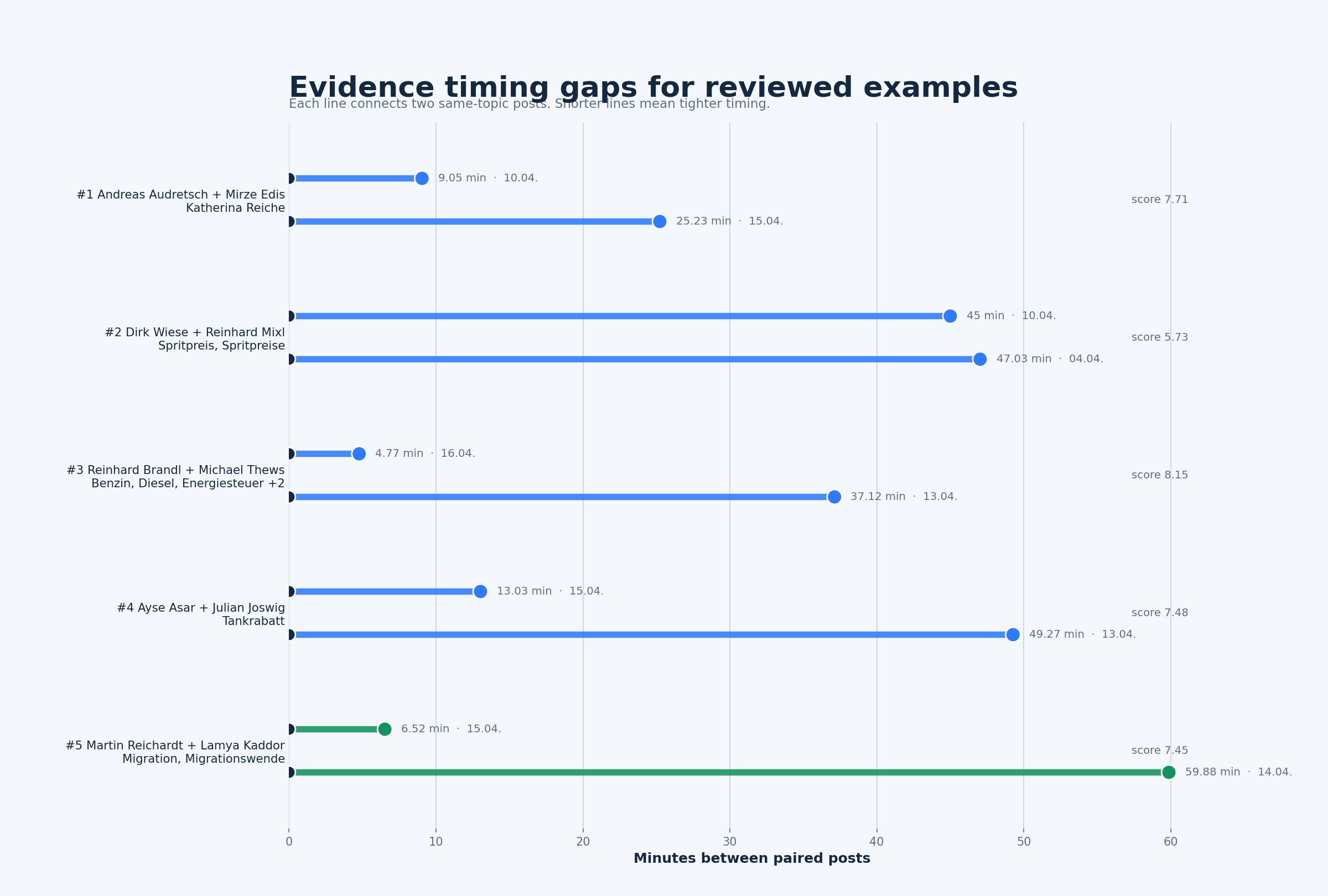
Five Final Examples After the 90-Minute Check
The following cards are the final public selection after deterministic search, Gemini triage, and Codex reclassification. They are not simply the first five hits in the raw ranking. The deciding factors were specific shared terms, recurrence across days, readable evidence posts, and a cautious interpretation of possible alternative explanations.
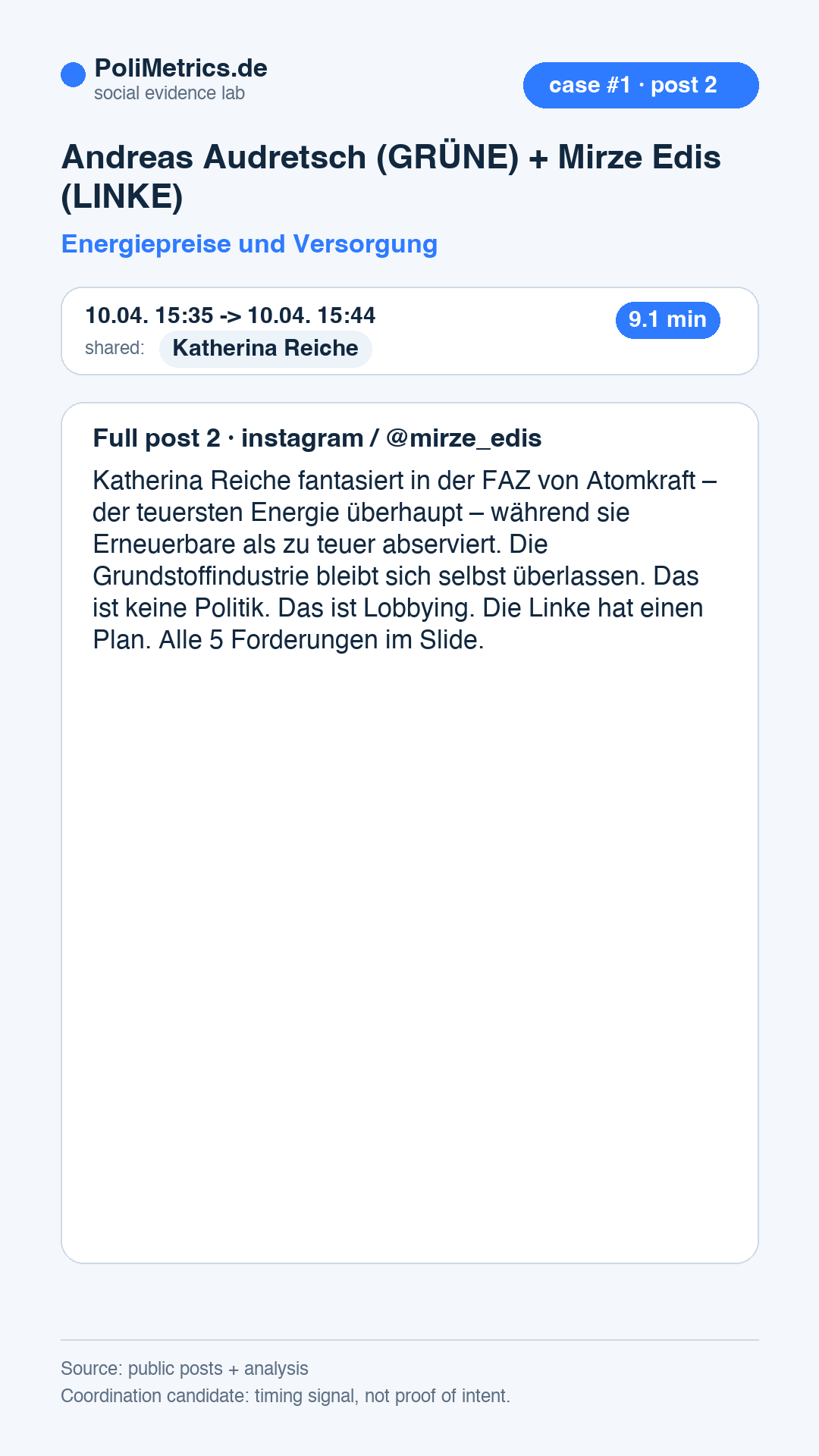
Andreas Audretsch (Greens) and Mirze Edis (The Left)
The strongest public example after final review. The shared reference is not just a broad energy term, but Katherina Reiche. The two pairs appear on April 10 and April 15, only 9.1 and 25.2 minutes apart. Substantively, this is an opposition criticism rhythm: energy policy is linked to personal political responsibility.
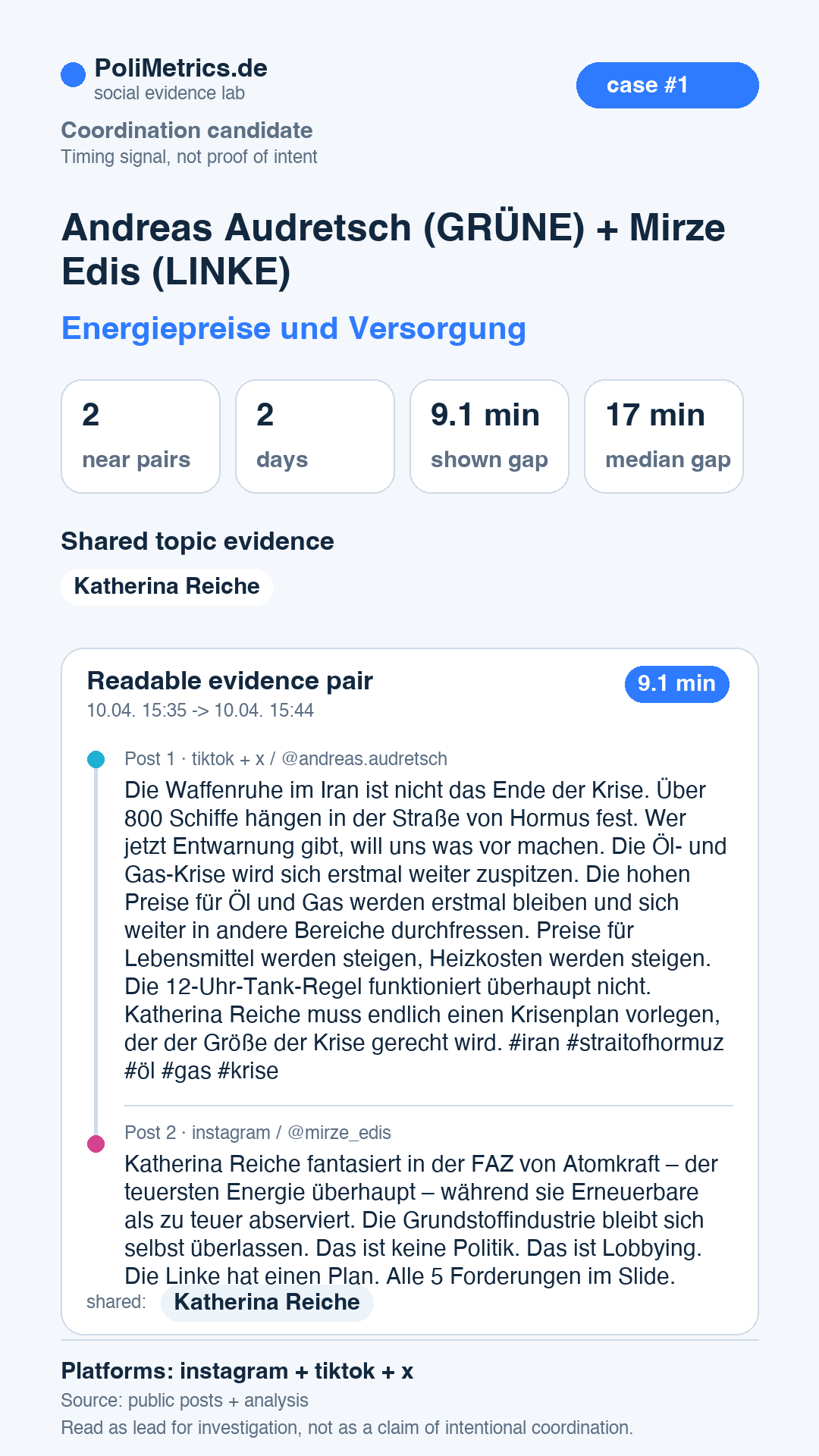
Show fuller evidence cards
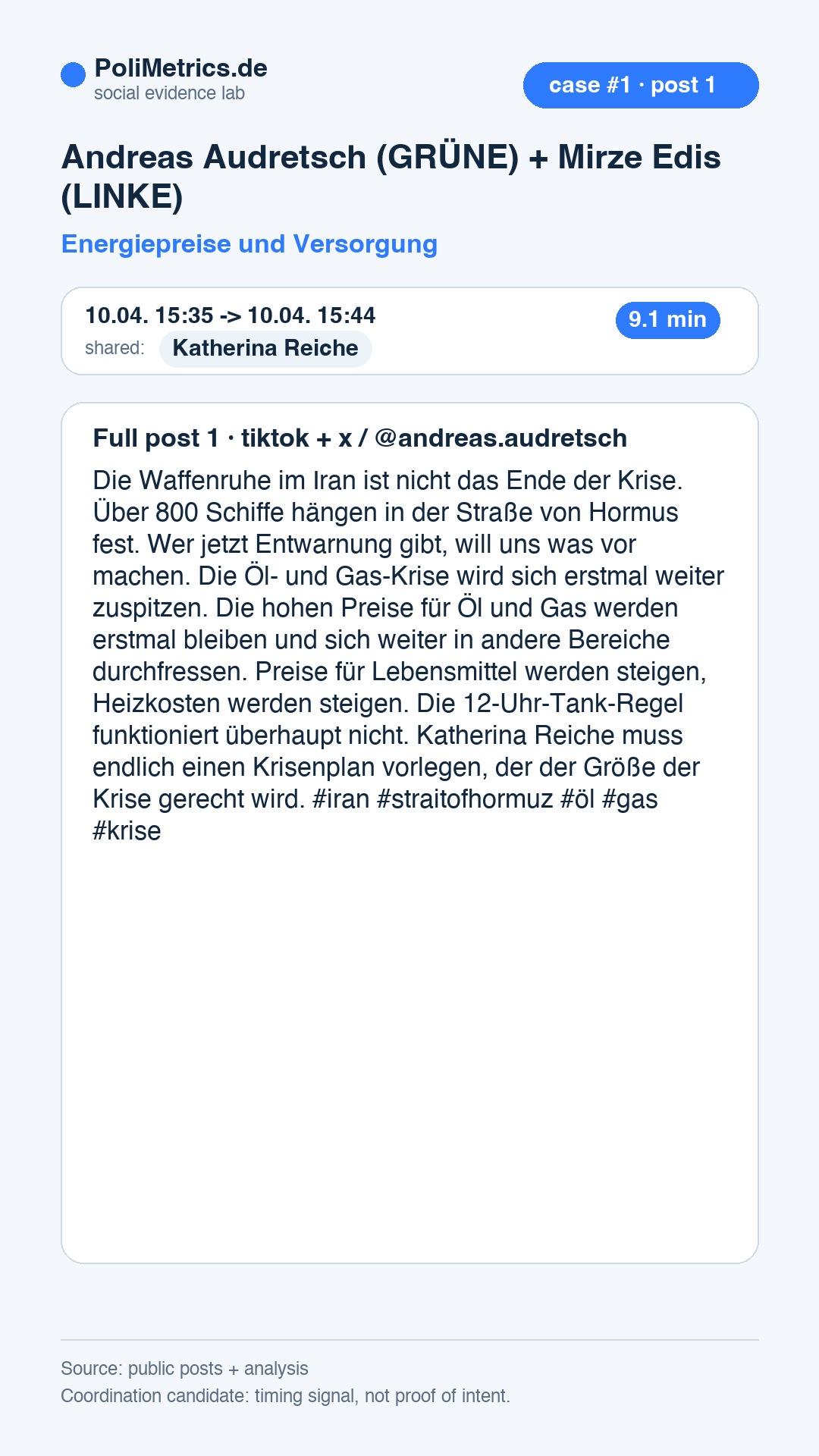
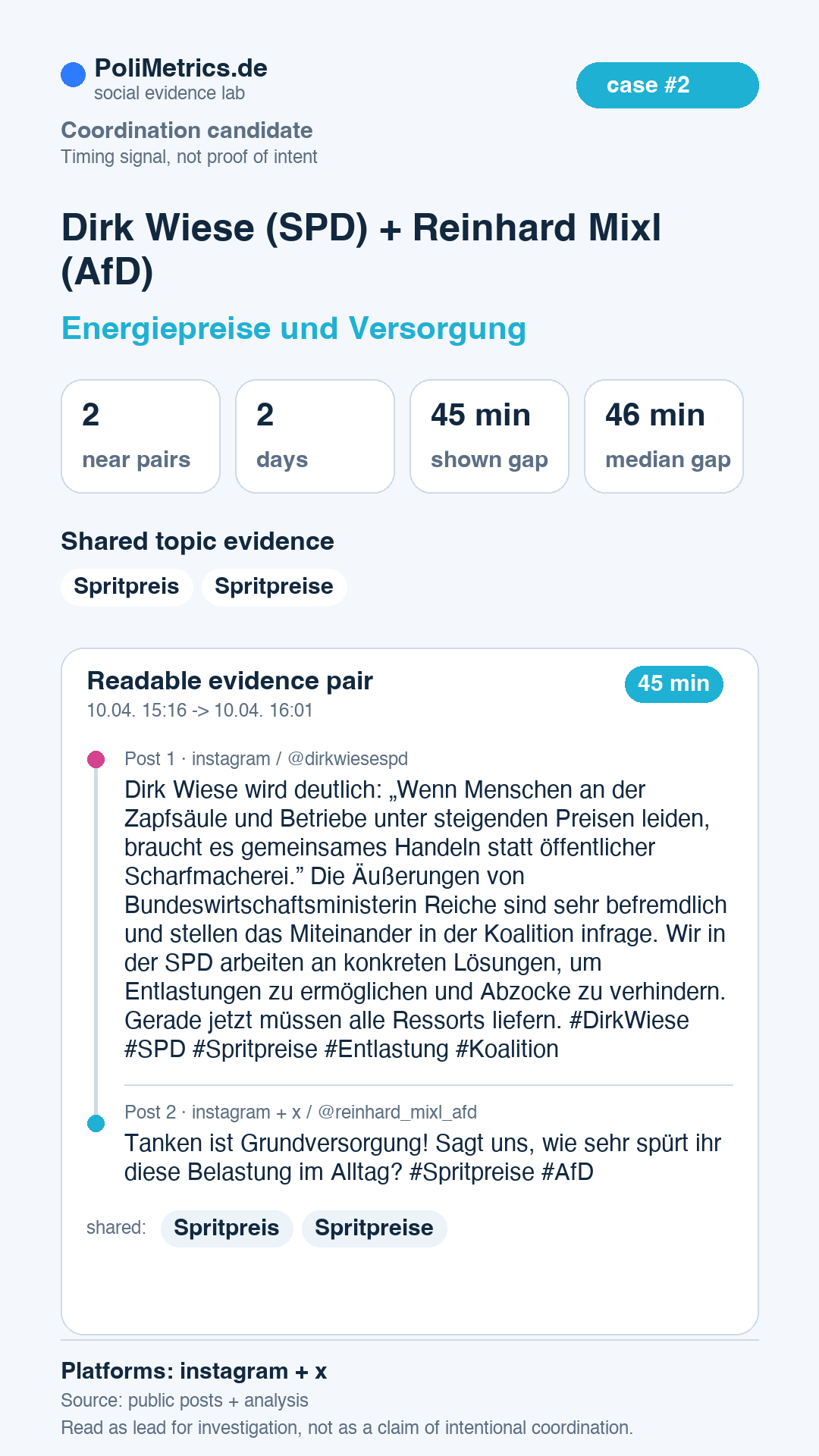
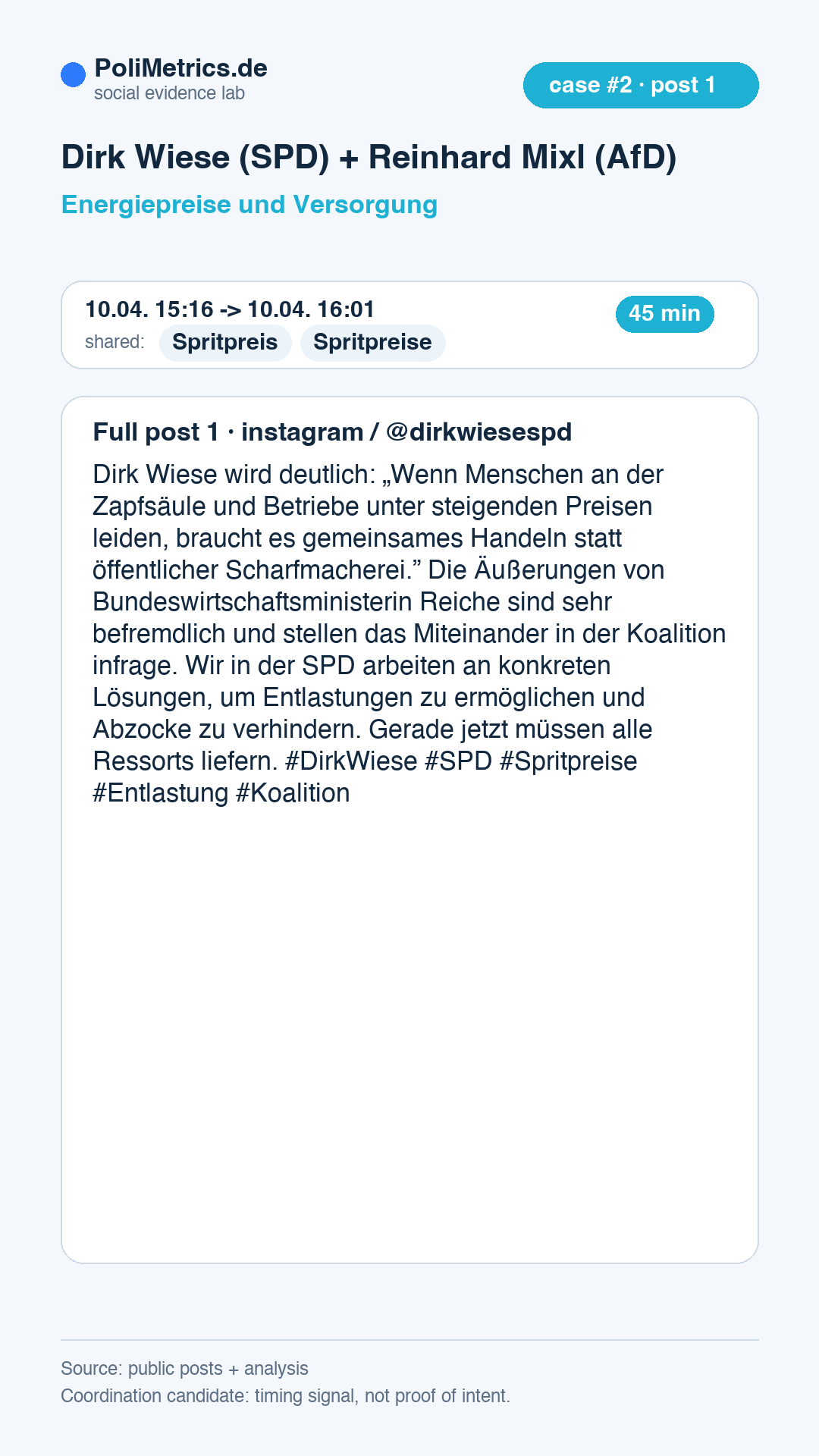
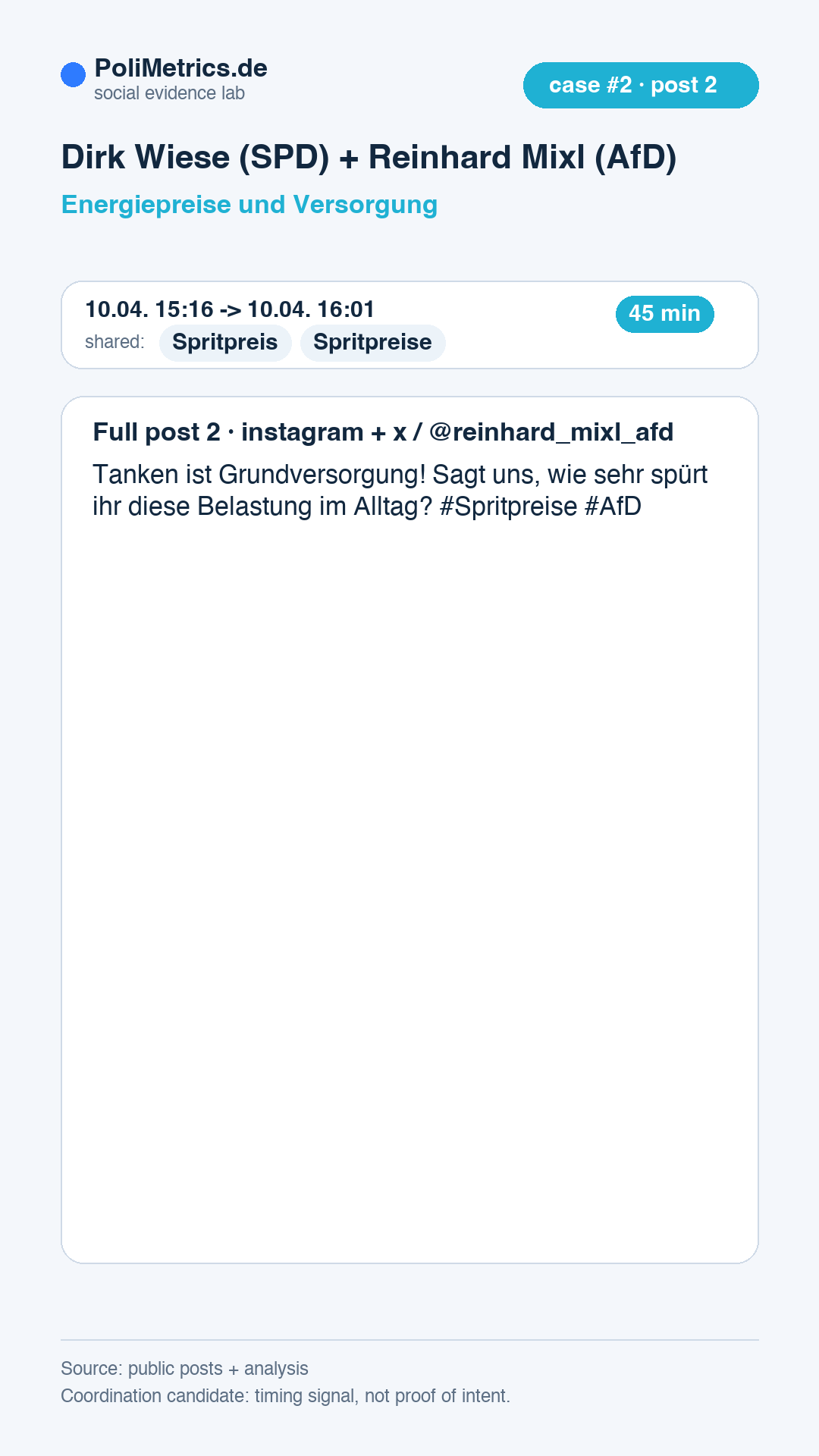
Dirk Wiese (SPD) and Reinhard Mixl (AfD)
This example ranks lower in the raw output, but editorially it is one of the cleanest. Both pairs are tightly about fuel prices and refuelling: April 4 with a 47.0-minute gap, and April 10 with a 45.0-minute gap. The messages point in opposite political directions, but they follow the same fast topic rhythm.
Show fuller evidence cards
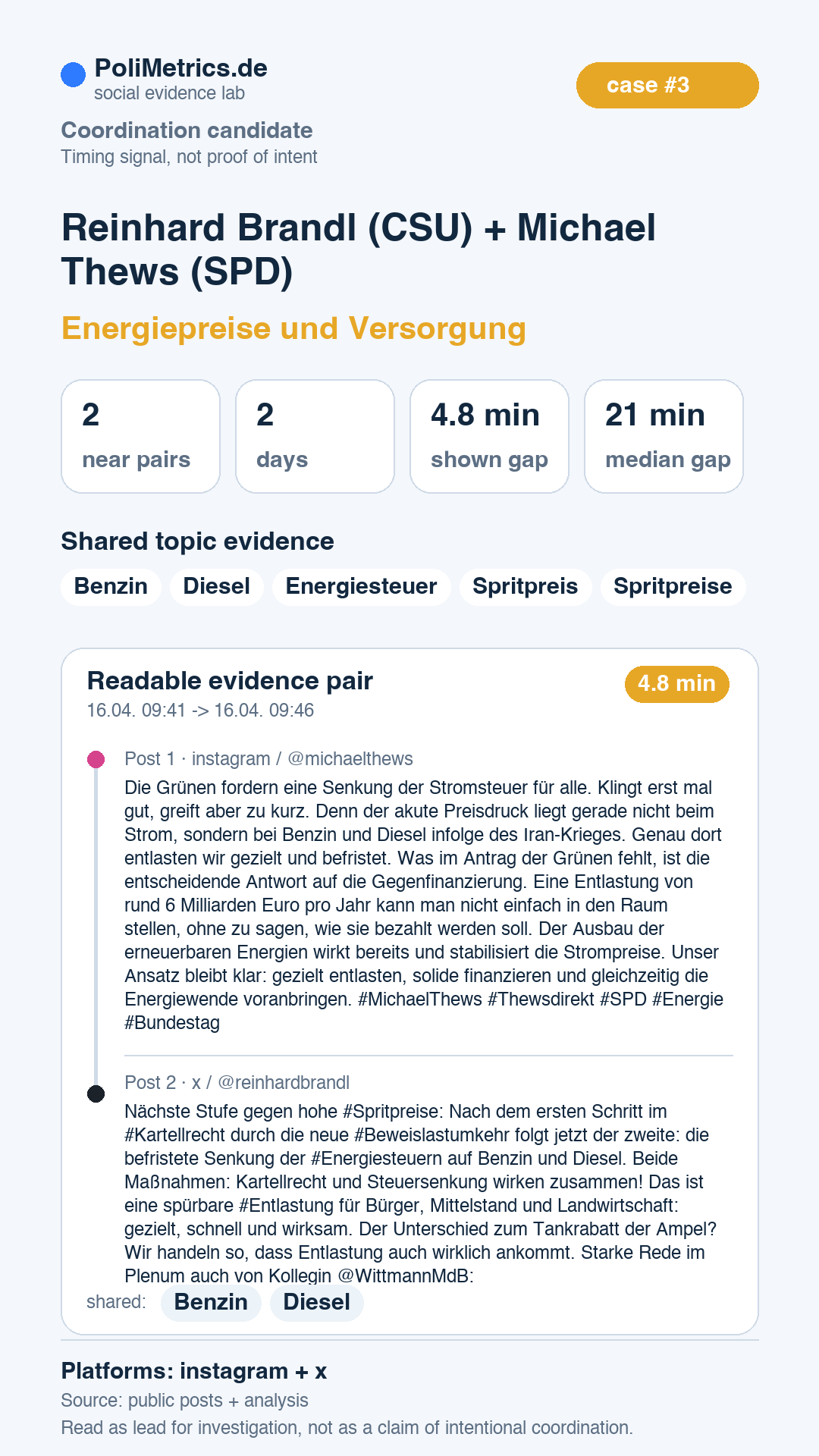
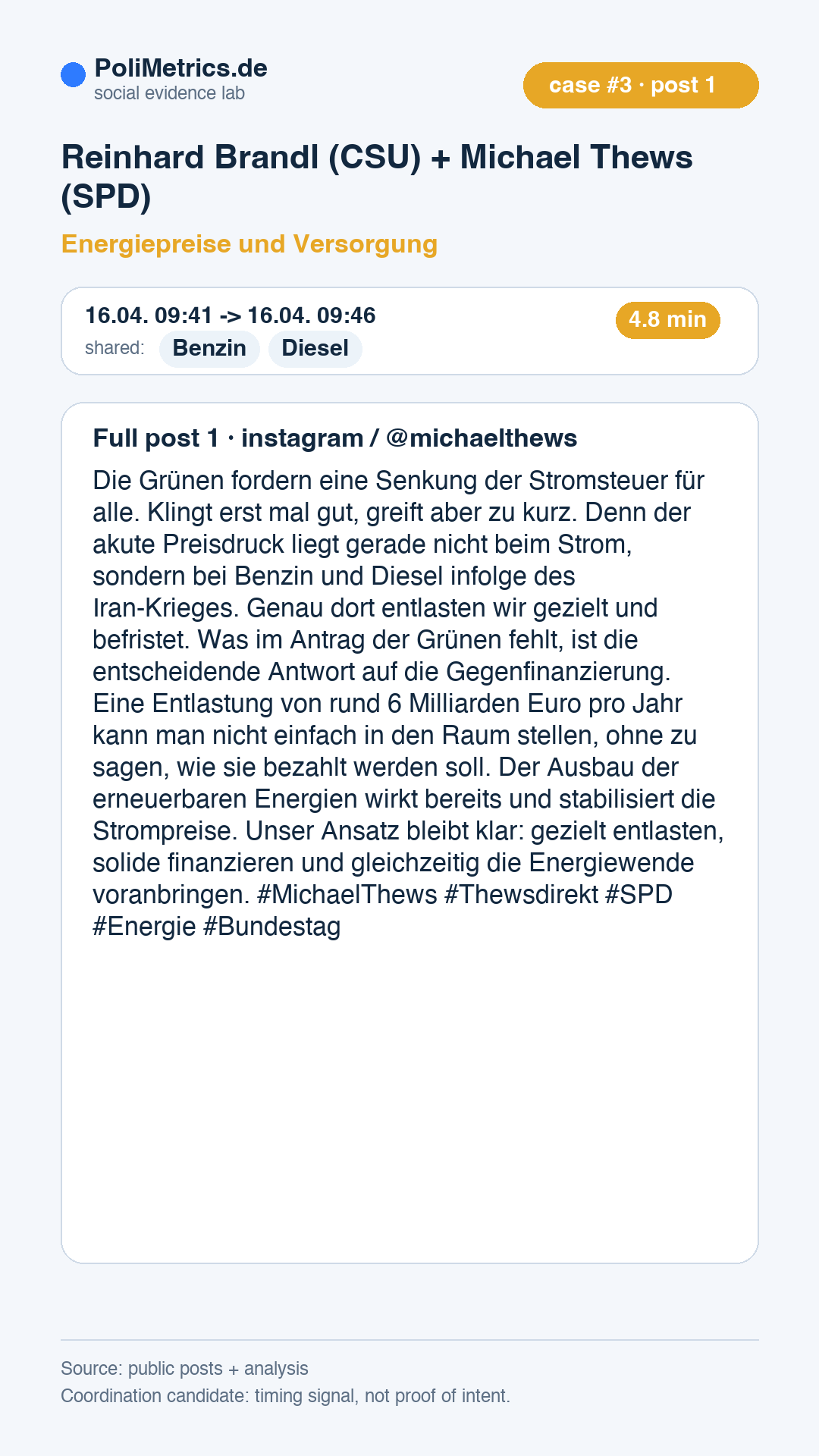
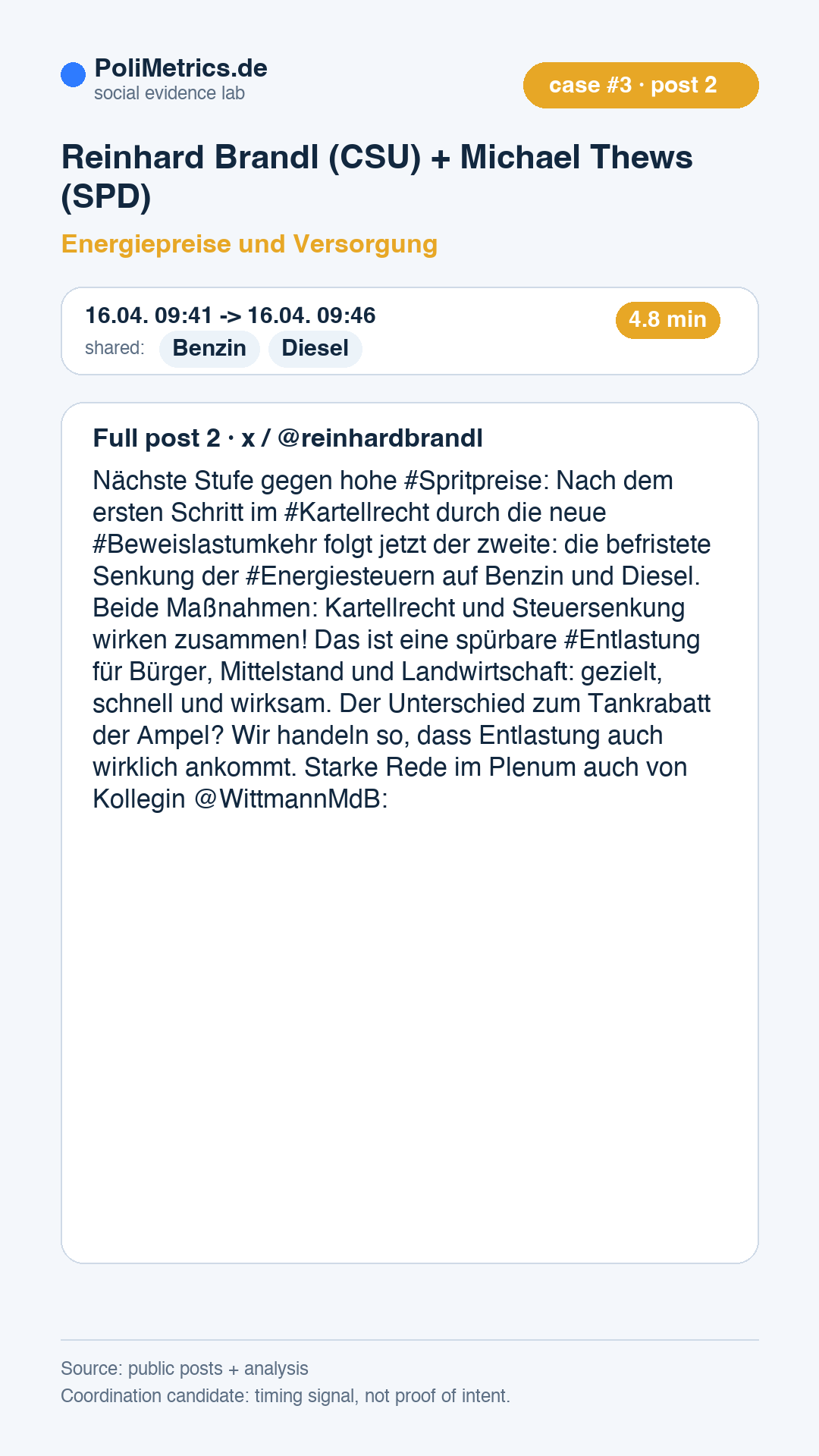
Reinhard Brandl (CSU) and Michael Thews (SPD)
The raw top candidate remains analytically strong, but it needs a careful reading. On April 13 both post about the coalition committee and fuel-tax relief, 37 minutes apart; on April 16 petrol-and-diesel posts follow only 4.8 minutes apart. This fits official government or coalition communication very well, so it is a candidate with a clear caveat.
Show fuller evidence cards
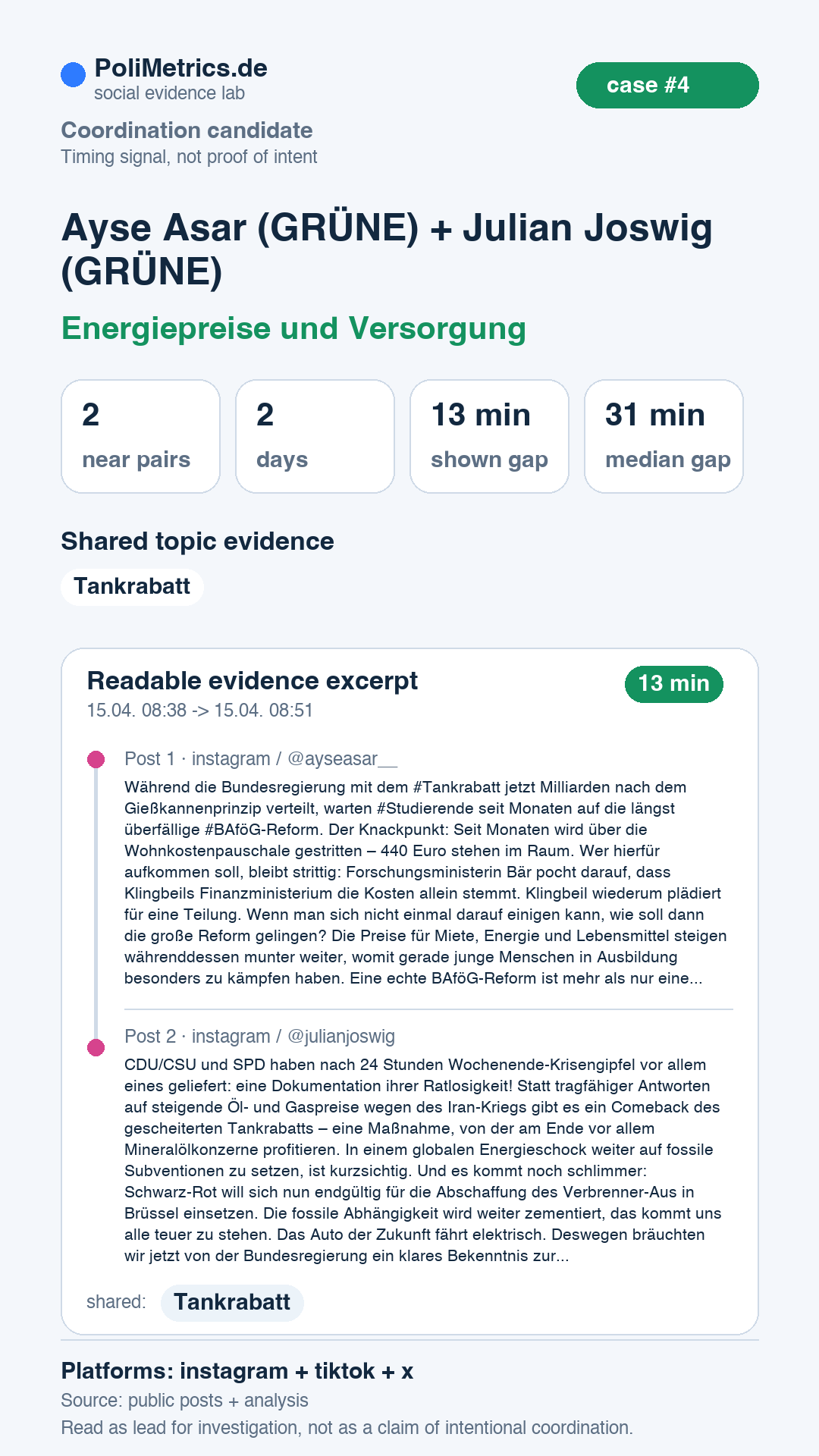
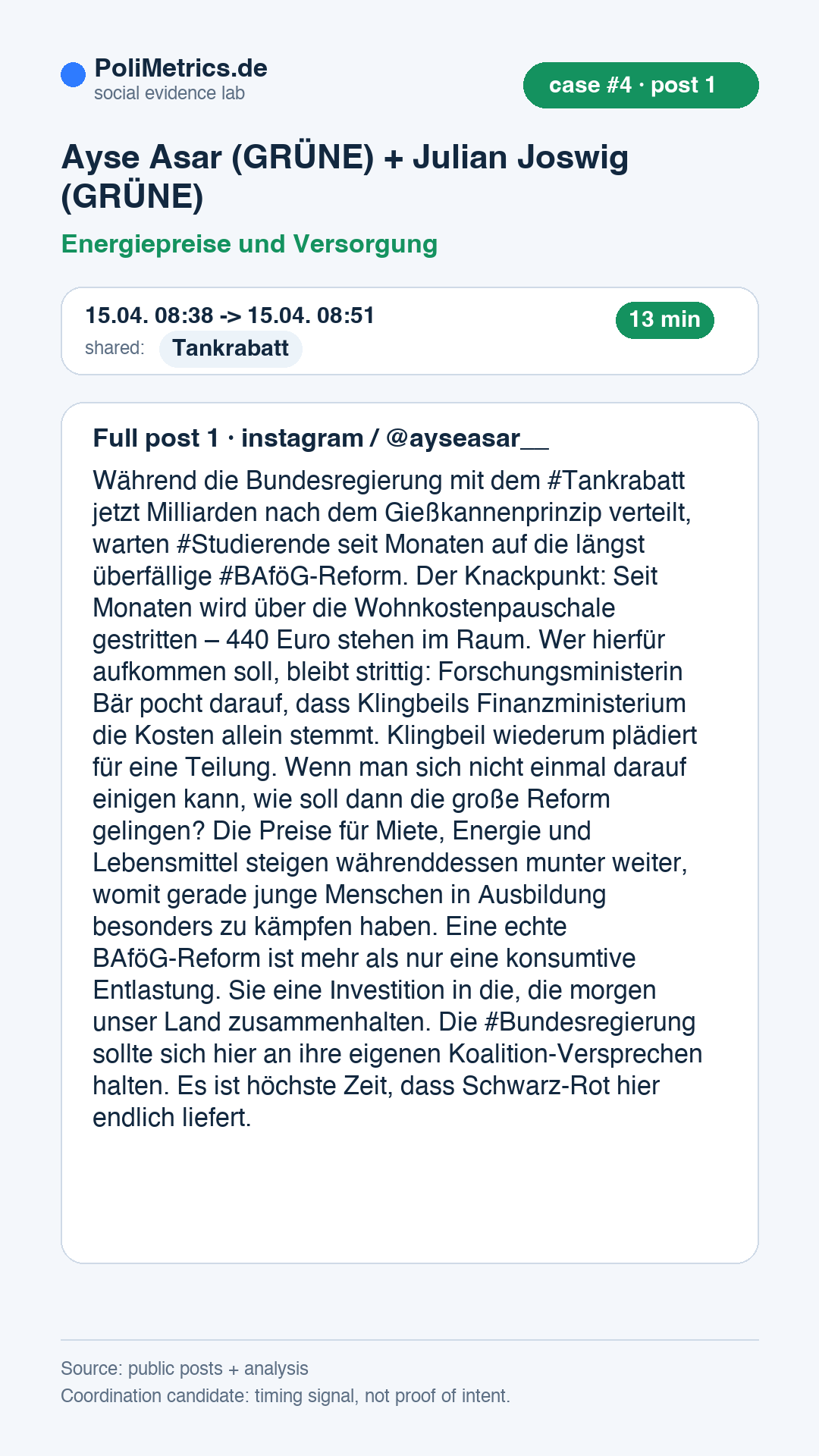
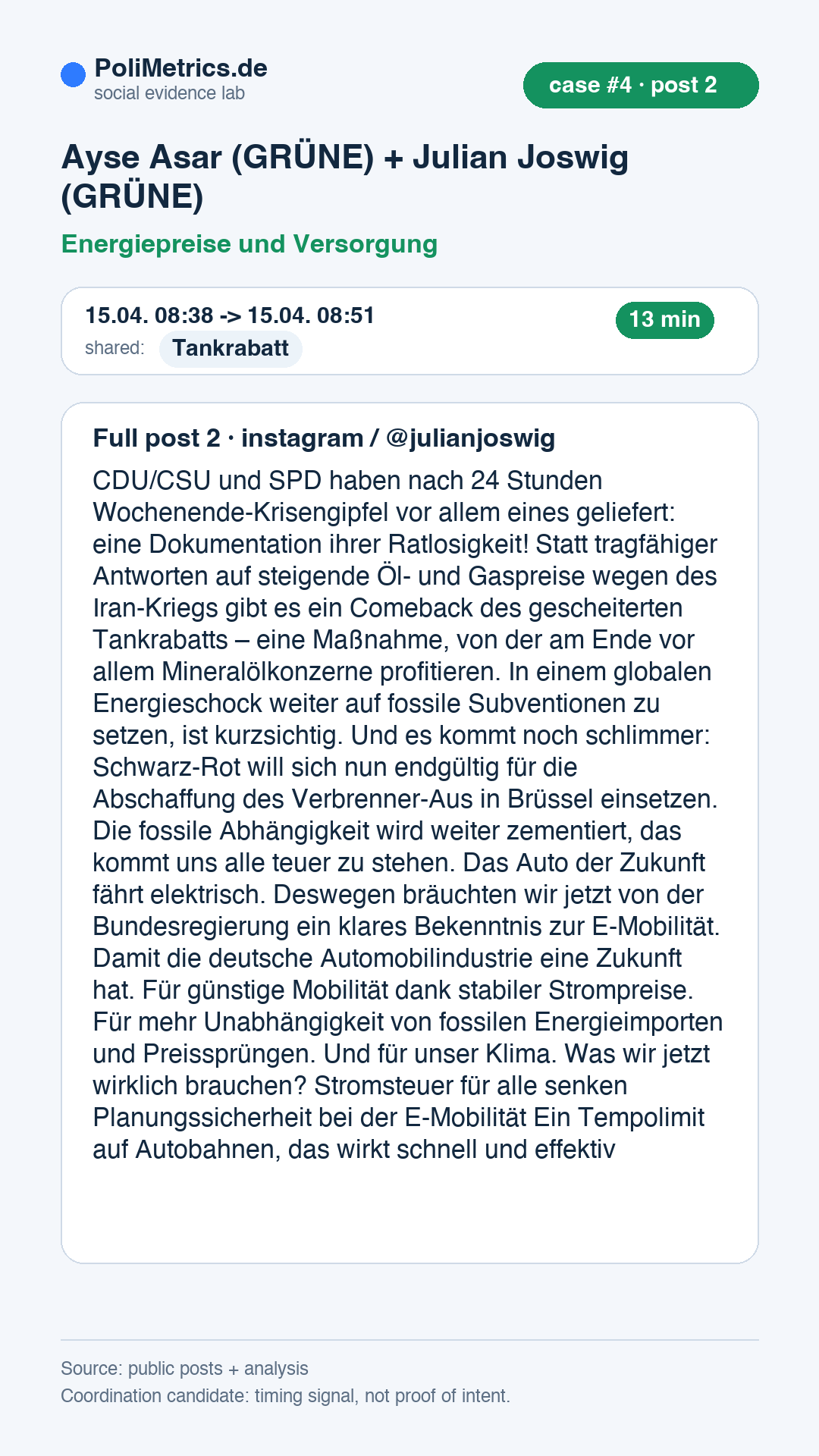
Ayse Asar (Greens) and Julian Joswig (Greens)
The shared term fuel discount makes this case easy to read. Both criticize the same measure on April 13 and April 15, with gaps of 49.3 and 13.0 minutes. Because both are from the same party, this is best read as a topic wave or message discipline, not as strong evidence of intent.
Show fuller evidence cards
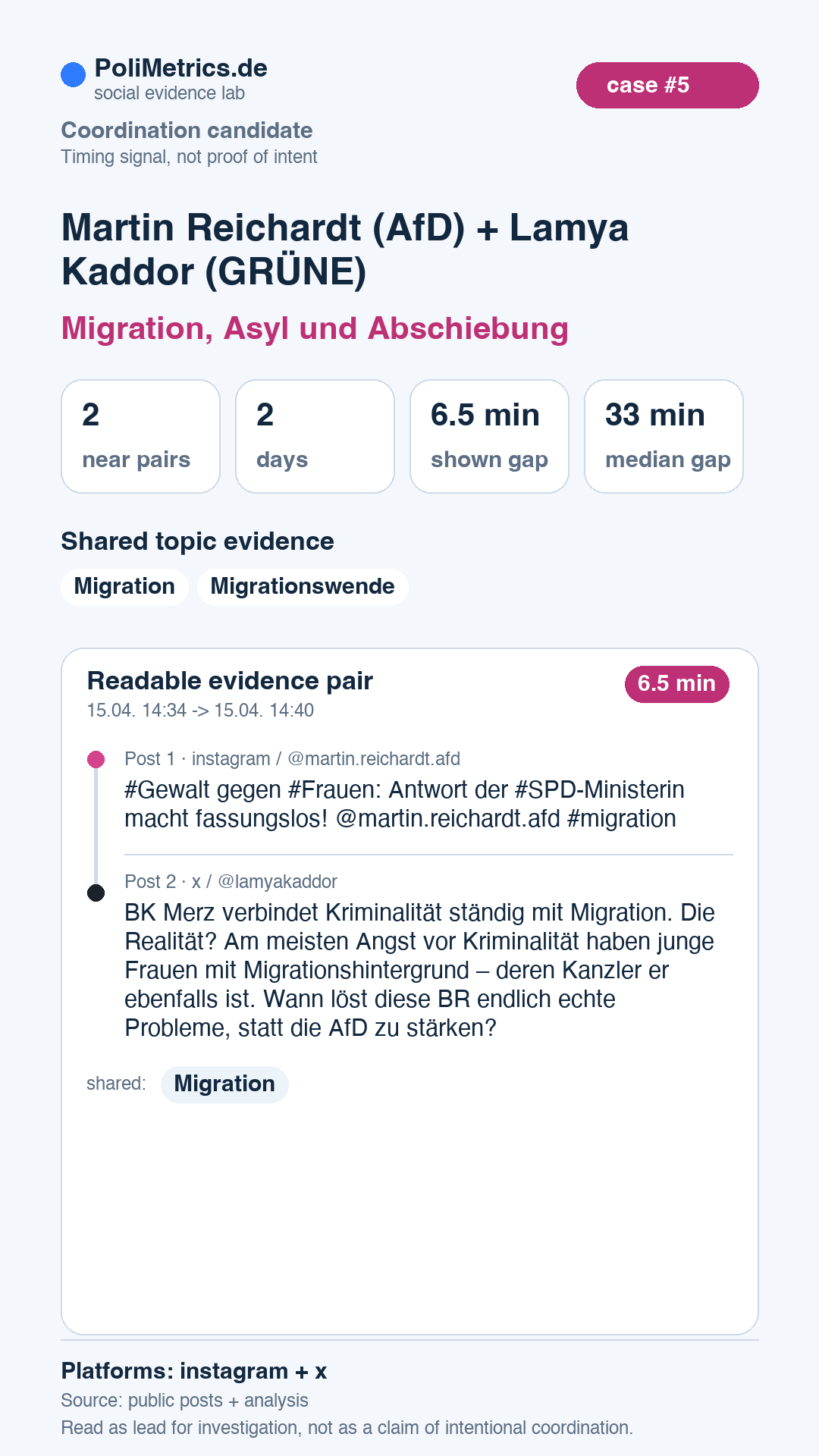
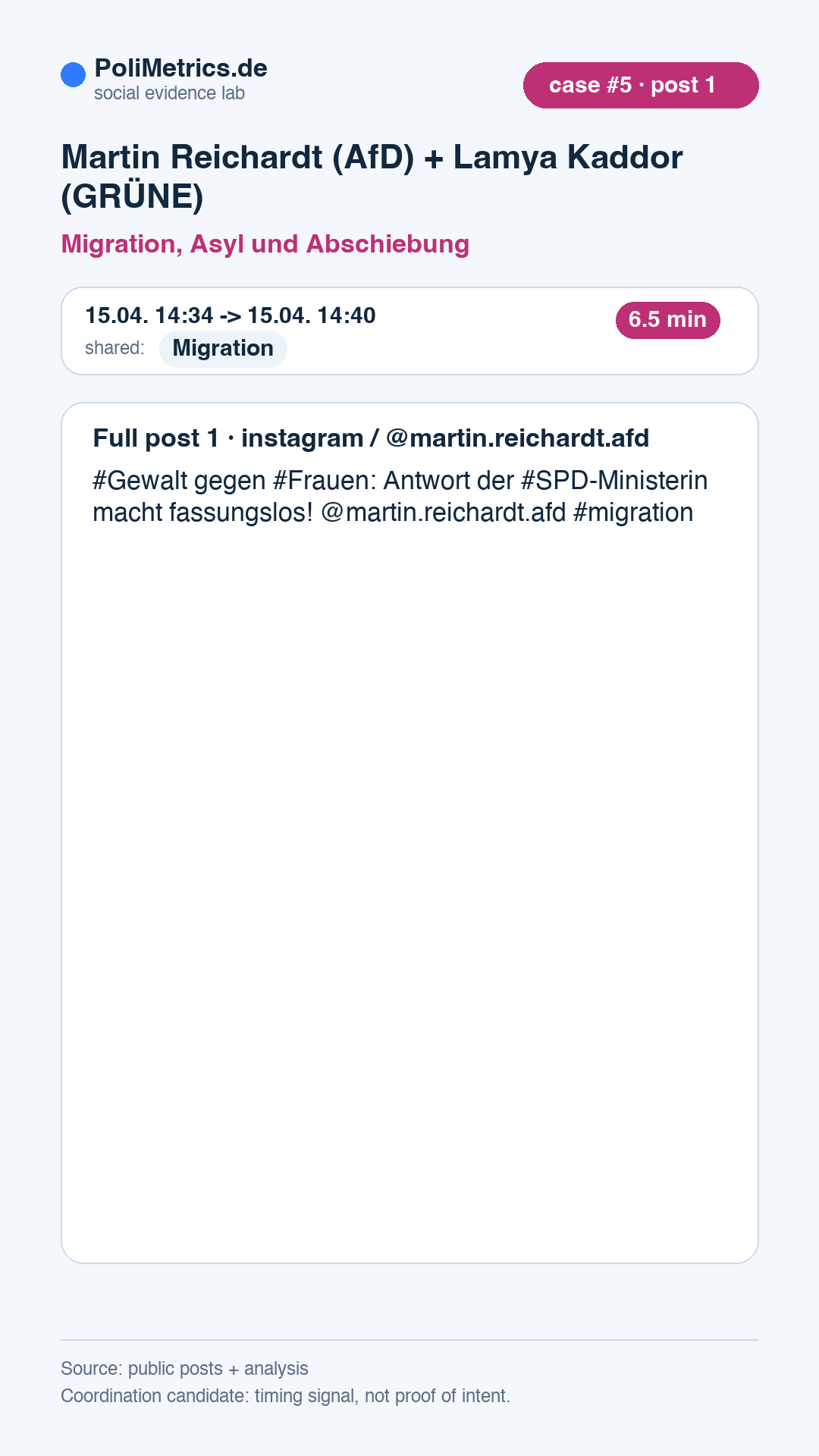
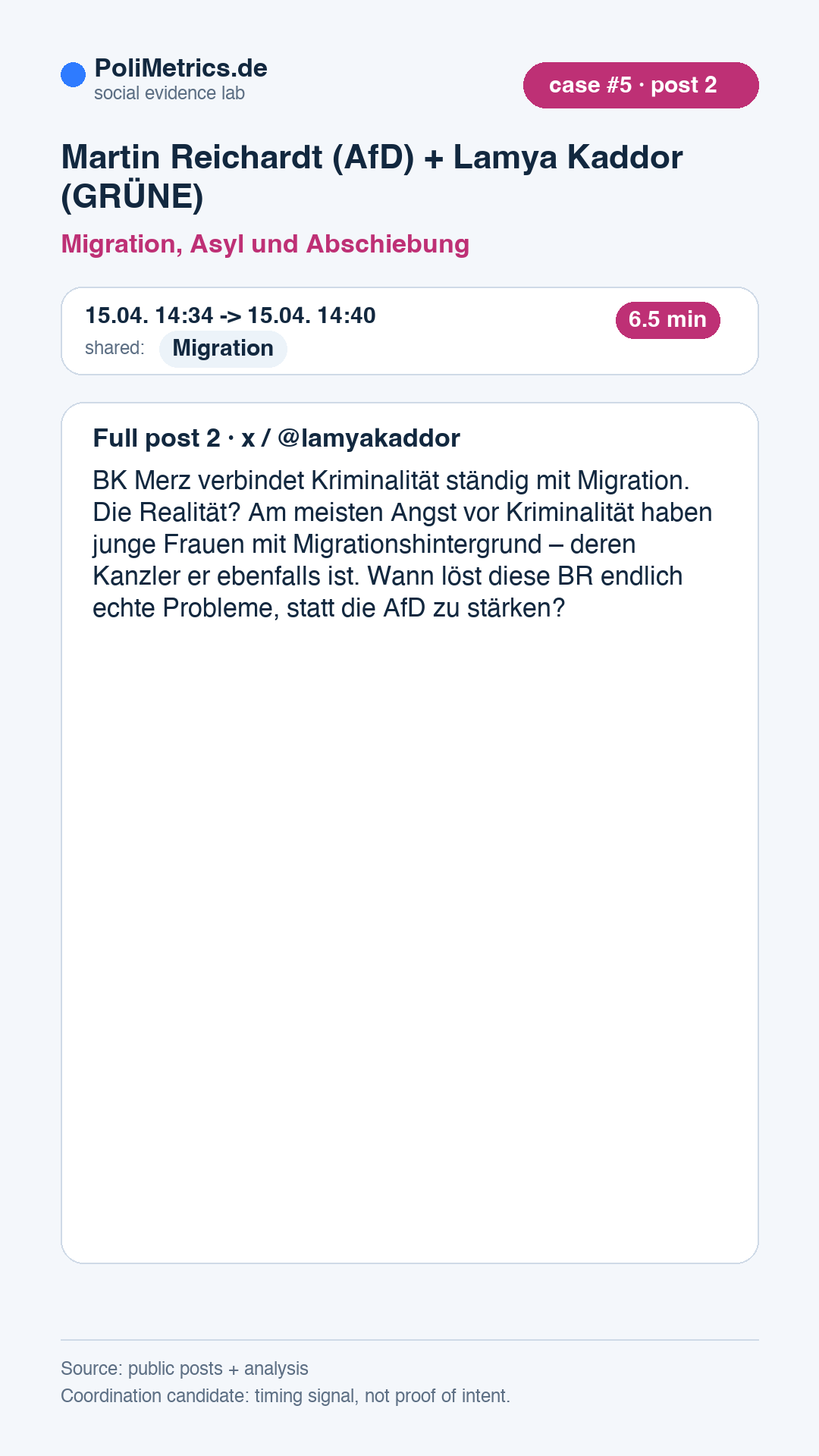
Martin Reichardt (AfD) and Lamya Kaddor (Greens)
This example is useful precisely because it does not show an aligned message. Reichardt and Kaddor post close together about migration and a migration-policy shift, but from opposing directions. The case is therefore best read as an agenda collision or shared news context, not as a coordinated line.
Show fuller evidence cards
Method and Limits
- All platforms were normalized into one schema: platform, post ID, politician, party, timestamp, topic, text, and engagement.
- Topic matching used deterministic curated keywords. This publication did not require a daily LLM or API step.
- Short posting bursts by the same author were collapsed so threads and crossposts do not create false extra hits.
- The final check counts pairs of different politicians who appear in the same topic within 90 minutes and share topic evidence terms: 1,467 evidence pairs and 25 raw candidates.
- Gemini 3.1 Flash Lite was used as an additional triage layer; the final public selection follows a stricter Codex reclassification.
- Direct replies, mentions, official government or coalition communication, and broad topic matches are treated cautiously because they may reflect news context or communication routine rather than independent coordination.